Showing posts with label food. Show all posts

Friday, December 13, 2013

International Food Night: PB& J Sandwiches
By Brandon Knight

This week I had the chance to attend something that many people never get to go to. I went to one of the International week days at Heidelberg’s own SRH. The SRH is one of the largest private institutions in the country, and known for its rigorous academic standards and unique was of teaching. For example, at my stay at SRH University their 5-week teaching method was explained to and after an initial feel of indifference I actually like this different approach to teaching a college course.  Essentially this process is self-explanatory, instead of 2-3 months for a course one at SRH may be taught for five weeks but much more frequently and rigorously. Also in these courses the conceptual knowledge behind everything being taught is very important. They aren’t just teaching you, so that you fulfill a requirement the staff at SRH genuinely wants it’s students to learn and master what they are being taught, and this I believe gives students learning here a little edge in the job market. I was truly nearly sold on this school, If I was a freshman interested in going to school abroad it definitely would be one of my top choices.
Moreover, now that I’ve gotten some brief history and facts out of the way, the event that I attended was called SRH International Week. International week is a very prestigious event that students from all over the planet come and take week long engaging courses and get to know someone. At the event there was people from New York, to here in Germany, all the way to seeing some students make the journey from Japan. For anyone considering going, my advice is stop considering and just go. It is well worth it. You will also be paired up with world class professors from around the world. These professors will actively and vigorously engage you on a topic of your choosing. Most of the topics were pretty interesting, for example I had Turkish Relation in the European Union and a friend of mine had a class dealing with start-ups. Though the work is pretty light on purpose, the way the class is taught will engage your mind to a degree where you will learn a surprisingly lot about what is being taught.
          
  There are also several events that are held throughout international week to give you a chance to bond with students. There are excursions that you could go on, though the Heidelberg Program covers most of them already. Though it never hurts to do something again, sometimes it’s more fun and then you can concentrate on interacting with your peers. The event I went was the International food night. I didn’t want to go at first because the first day was so long but I decided to go anyway. I’m glad I did as every represented school makes a dish there was plenty to try. So I suggest go on a near empty stomach if you want to sample all it has to offer. The most surprising thing to me though was the dish my school contributed. We made peanut butter and jelly, and back in the States it doesn’t get anymore basic than that. At first I was almost embarrassed since I was sure everyone had before and it lacked that exotic appeal. However, I kid you not, there were less than 8 people who had eaten it before at the whole event I counted. I was literally amazed so few people had tried PB&J outside the U.S. I guess you never know until you venture out and learn. I learned that it is very important to put oneself out there and try something new. So overall I’d highly recommend anyone that has a chance try the SRH International Week.

http://www.hochschule-heidelberg.de/de/internationales/international-week/international-week-2013/
  

Tuesday, December 10, 2013


Trying Something New
By Jennifer Dall

            Before I came to Germany, I never drank alcohol and was never interested in doing so. Getting drunk never appealed to me so I stayed away from even tasting drinks like wine and beer. If you asked any of my friends or especially the people on my freshman floor, they would tell you that I was even a little closed minded about the topic. 
            Now, deciding to go to Germany changed all of that. In the country that gave birth to the world’s largest beer festival, was I going to still block out drinking? Was I going to deprive myself of experiencing something that is so culturally significant to the country that I will be staying in for four months? The short answer is no. The long answer involves me sitting in my bed trying to reevaluate my life decisions but eventually, still comes out to a solid no.
Too long have I been stubborn about something that really is not a big deal. I have come to the realization that drinking is not a 0 to 60 phenomenon. Just because I decide to drink one glass of wine or one mug of beer does not mean that I will wind up in the bathroom an hour later puking my brains out. I consider myself a very responsible person and I refuse to let my fear of losing control hold me back from having the best experience possible while studying abroad.
The wine tasting excursion is the perfect example to prove my point. The old me would have been annoyed by the mere fact that an event focused on alcohol was worked into the schedule. I would have immediately cast the excursion aside as pointless and dreaded that impending day that it would arrive. But now, after pushing myself to be as open as possible to new experiences, I embraced the wine tasting. I even looked forward to it. It was the perfect opportunity to test my new frame of mind.
By being so open, I learned to appreciate wine making as a family business and as a passion. The woman who guided our tasting is part of the ninth generation of family working continuously to make Adam Muller wine. When she spoke about her family and the wine that she presented to us, I could tell that she was extremely proud of her family’s work and its long rooted history within the town of Heidelberg. Between her passion for wine making and the quaint living room setting of the tasting, I felt comfortable enough to indulge myself in drinking each glass of wine.

During those couple hours, I kept thinking back to freshman year and how far I have come since
then. Not only was I mentally ok with sipping on wine, but I was in the company of friends and teachers doing the same thing. Nothing bad happened to me or them and I was able to enjoy another side of Heidelberg that is somewhat off the beaten path. This experience has definitely encouraged me to continue my efforts of keeping an open mind to new things I may come across while studying abroad and during life itself. I greatly enjoyed the wine tasting and am looking forward to more positive new experiences down the road!

Monday, December 9, 2013

The German Recipe
By Leah Martindill


            One of my goals of studying in Germany is to go home recognizing every day, useful German words. I do not expect that I will be able to pronounce or spell them all correctly but if I can just know what is being written or said I will be satisfied. I figured a good way to learn a few household terms in one go would be to follow a German recipe. Not necessarily German food but a recipe in German. I decided I was going to do this and then the recipe was literally just handed to me.
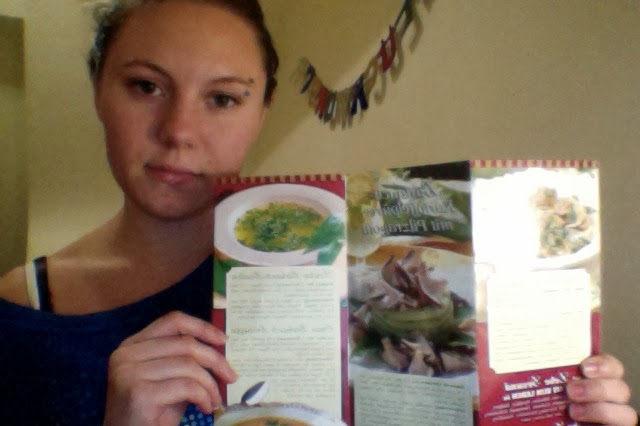
            Over the weekend I went to the red-tape event in town. During it, there was a women standing on the sidewalk handing out samples of toast with a pesto spread on it. I tried it and it was absolutely delicious. They also told me that it was vegan and could be stored for up to half a year if refrigerated. It did cost nine euros, which is a bit over my budget so I did not buy it right away. I thought about it and decided it was a worthy investment. It was now two days later and I had to wander around a bit to find the store again. It was quite the walk and I arrived sweaty but excited. Then as I was checking out the women handed me a list of recipes to make with the spread. I was headed to the grocery store afterwards anyways and decided to see if I could find the ingredients I needed.
            I went to the Penny grocery store, which is near Bismarkplatz because it was on my way home. I tried to match up words for the ingredients with the words on the sign at the store because I did not really know what any of them meant. I did know that I was trying to make pesto mashed potatoes though. The recipe I was following is called “Barlauch-Kartoffelpuree-mit pilzragout.” Literally the only word I knew was kartoffelpuree, or mashed-potatoes. So I headed to the potatoes first. Then something interesting happened. This girl from Scotland was looking for lactose free yogurt and asked for my help. I, of course, had no idea where to look for that but I helped anyway. Then I had her helping me try to figure out the recipe. We never did find her yogurt but we were able to a lot of the stuff for me.
            I needed muskat which is nutmeg, shiitake pilze, or shiitake mushrooms, sojamilch, which is soymilk, and I did not figure that out at the store so I just ended up with regular milk, and sahne or cream.
            The recipe itself basically was to make mashed potatoes and add all this extra stuff into it so I didn’t have to translate too much to do it. I got the words for mix, stir, pour, boil, etc. so it was a pretty cool experience.

            The mashed potatoes turned out pretty good but I do not think I will often go through the effort to make them again, but maybe. I accomplished my goal of figuring words out and although I am sure I will not remember them all I hope I will be able to recognize a few of them here and there. This is definitely something I am going to try again. 
Chocolate Love
By Sumaiya Rahim

            I chose to not attend the Wine Tasting excursion for religious reasons, and instead, decided to make chocolate mousse. Some may say that my obsession with chocolate is a little unhealthy. I then, would have to completely agree. I am obsessed. I love chocolate. Dark, white, and especially milk, the kind with the nuts in it (not the one with the fruit though), as long as its decadent, creamy, melt in your mouth chocolate, I am happy. My favorite however, would have to be chocolate mousse. When made right, it is airy and fluffy. It isn’t too heavy or overpowering and if you have it with coffee, maybe something bitter, or on top of a dark chocolate cake, I promise your mouth and taste buds will thank you.
            I was craving chocolate cake in Germany but was having so much difficulty finding the kind of chocolate cake I have back home. However, I did come across many places that served black forest cake, and also, chocolate mousse cake. I found that buying these German delicacies was becoming more and more expensive and as the euro to dollar rate is at a 52 week high of 1.38, I really could not afford to keep buying chocolates, and cakes!
            I made a much-needed trip to ReWe and bought a mix with instructions on how to make chocolate mousse! The directions were in German, but with a little help from google translate, asking the cashiers on the ingredients needed, and then with the help of some more goggle translate, I knew everything I needed to make “Mousse au Chocolat!” The directions when translated said, “Give 250ml of cold milk into a tall mixing vessel. Add the contents of the bag and mix well with an electric hand mixer on the lowest level. Then strike the highest level about three minutes.
Pour the cream into dessert glasses or a glass bowl and set at the minimum 1 hour in the refrigerator. It tastes best when the cream is very honored immediately afterwards. They should not be kept longer than a day in the fridge.” Though the translator definitely said things in a strange way, it was easy to understand.
            Simple right? Even I was shocked! I was sure that there would be more to it, but there wasn’t! I did have to make another trip to Lidl because on the tram back I realized that I hadn’t picked up milk while picking up the other groceries on my list! I came back to the ESC though and happily and whisked away until I thought I had the perfect mixture of Mousse mix and milk.
            After an hour in the fridge, I tasted it, and it was delicious. I was hoping for more of an “airy” texture, and my mousse turned out to be more pudding like than mousse like. I learned that I liked the “Ruf” brand, and I am very open to trying out the other brands of Mousse I saw at the market! Anja, Gerard and a few other people tasted my mousse and loved it. It was definitely the perfect after-dinner dessert that I can have over and over and over again. Chocolate wins again.


Monday, November 25, 2013

Das Bier: Oktoberfest


By Amanda

When I think of Oktoberfest, the first word that comes to mind is: beer. In Hyde Flippo’s book, When in Germany, Do as the Germans Do, he goes into further detail of the history of beer. The word “beer” comes from the Anglo-Saxon word barley, “baere” denoting back to the 5th century (Flippo, 2002).  Beer was an important drink in ancient cultures for the Egyptians, Incas, Sumerians, and Chinese (Flippo, 2002). These cultures used beer for religious practices and curing sicknesses as well as an upscale drink for bartering trade (2013). Centuries ago, beer was solely made out of barley, hops, yeast, and water (Flippo, 2002). In today’s culture, beer is typically made of the same ingredients, including the original barley and hops with additional ingredients such as fermentable carbohydrates (maize, wheat, rice etc.) and other natural ingredients to create a vast variety of flavors (2013). This past weekend, I was fortunate enough to attend Munich’s 180th annual Oktoberfest on opening day.
           
There are fourteen large tents set up indoors and outdoors for Oktoberfest which serve over six million people during the sixteen day festival period. Over seven million liters of beer are consumed which equates to each person to approximately drinking one full liter of beer (an entire stein). A rectangular blue and white sign is framed at the top of the entrance reading, “Willkomen Zum Oktoberfest”; this was the moment I had to pinch myself to realize I was not dreaming.
I had reached the Hofbräu-Festzelt tent (which is the biggest of all fourteen tents) at eight o’clock in the morning. The crowds were growing by the minute, but at least our group of four was only a couple hundred feet from the entrance. However, once the clock struck nine, the gates opened and people stampeded for the entrance like nothing I have never seen before, worse than any Wal-Mart Black Friday video I had ever seen. People were jumping on tables, running and shoving through the crowds to make way for a spot at a table. That’s the gist at Oktoberfest: if you don’t receive a spot at a table, you will not be served alcohol in the tradition style. It was pertinent to find a space, so as soon as I burst through the crowds, my friends and I ran to the back as fast as we could.  We were lucky enough to grab a table and meet up with another one of our friends, but we still had another three hours to kill before the keg would be tapped. The opening of the keg signifies the start of the festival and no alcohol is served until that joyous moment.
In anticipation for the opening ceremony, marching bands of local townspeople and children
paraded the tent. Everyone in the beer hall was singing until the mayor came out to give the opening speech. During the final ten second countdown, all I could hear was thousands of fans cheering in excitement for the first rounds of beer.
Once the first keg was tapped and the beers started coming out in one-liter frosted mugs, everyone in the hall just got a little bit crazier. At least every minute there was a new group yelling “PROST!” and clinking glasses while standing up on the tables. Some brave souls chugged beers with a support system of fan groups cheering them on from all the way to the back of the tent. The hall was buzzing with incessant laughter and jokes; simply put, it was a huge party and everyone was just looking to have a fun time. There was something electrifying in the air though, the influx of energy in the room was indescribable and everyone had a smile on their face.  It was one of the most sensational events I have ever experienced, certainly a big check off of my bucket list.
It was hard when it finally came down to leaving the festival at the end of the day. My last sight of the day was of the rainbow, vibrant colored lights, rides, with everyone classically dressed in dirndls and lederhosen flooding the streets. I could not have asked for a better experience, Happy Oktoberfest!


References
Flippo, Hyde. When in Germany, Do as the Germans Do: The Clued-in Guide to German Life,    Language, and Culture. (2002). 50.  Chicago: McGraw-Hill.
Beer Academy, The Beer Education Trust. (2013) What is Beer? Retrieved from             http://www.beeracademy.co.uk/beer-info/what-is-beer/


Monday, November 18, 2013

The Questions You Should Ask . . . 
By: Liam Walsh

             The first article I read from “When in Germany, Do as the Germans do,” is titled “Questions you should ask – part 1.” In this article it proposes three questions you should ask yourself before you leave for Germany. I found this article to be ironic but eye opening because I read it after I already left, but it gave some insight to activities that I already performed without thinking much about it.
            The three questions that the article asked were: 1) Will my credit card work in Germany? 2) Will my cellphone work in Germany? 3) How about electricity and appliances? The reason that there are important question to think about before leaving is because European and more specifically German standards of living are much different then those found in America.
            The article breaks down the questions one-by-one and gives us their answers. For question 1, they say that most major credit cards are accepted in restaurants and shops that take credit cards; however they do note that not all stores accept credit. For question 2, they wrote that phones from North America won’t work Germany, but phones from England will. Lastly, for question 3, they say that German electricity comes in 220-volt, 50-hertz variety, which will destroy most North American 110-volt appliances without a converter.
            After reading the article I thought about my experience with my first week in Germany, and how this questions applied to my stay so far. For the credit card, I know that I can take money out of the ATM near by, which I might be doing often. It’s rare that I see a store that takes credit cards at all. I think REWE does and Sports Arena does, but my theory is that they only do so because they are major chains in a touristy area. For the second question I already dealt with my phone before I left. I called Verizon (my carrier) and let them know I was going abroad. So my phone can make calls and send texts because I’m on the Vodafone network. However, I should note that I don’t use the phone unless I am connected to Wi-Fi. As for the third question, I have a converter plug to use for my phone and laptop, however I don’t have a transformer so my alarm clock that I brought won’t work.

            Throughout the text I found that the article’s questions and answers are mostly correct. The only reason I say mostly is because with IPhones 4s and 5 you can have international usage, so through a technicality I can use my phone, but I still choose not to so I don’t have a major debt when I get back.  The lesson I learned from reading this article and thinking about how it relates to my first week here is that before you travel anywhere, outside the country or to another part of town, you should always think of how different it can be, similar to how in New Jersey you can’t pump your own gas, yet in New York most gas stations are self-service.

Friday, November 15, 2013

Traveling Abroad
By Ewa Szyszko

On my first stop of my almost two week long adventure exploring Europe, I visited the country of Belgium. I was excited to visit this country for two main reasons. One, this would be an amazing personal and cultural experience. And two because they are known all around the world for their world famous waffles!
            On my first day in Brussels Belgium, I got to experience my first taste of waffles. My friends aunt, who we were staying with, was kind enough to take us to one of her favorite waffles spots in the heart of the city. This was the moment that I had been waiting for since long before this trip had even been planned. This moment had been very high on my personal bucket list, to eat real authentic Belgian waffles.
            We entered the restaurant and seated ourselves before a waiter came around to drop off some menus for us to peruse. The moment I opened that menu I knew I had come to the right place. In the menu they had two type of waffles offered on their menu. They had the world known Brussels waffle and the Liège waffle (europeancusines, 2013). The time was right, the menu had a wide selection of toppings for my waffle and the price was right. At a whopping price of 8 euros I had struck gold. Looking at the menu and all the listed toppings available for my choosing, it soon became very difficult for me to agree upon. But lucky for me, on the back of the menu there was pictures of combinations the creators of these waffles had made up to help customers like myself decide on something.
            I had decided upon the chocolate, whip cream and strawberry waffle. This would be my first waffle I ate in Belgium and the point where I could cross this event off my bucket list.
            I placed my order along with my friends that I was traveling with. I waited patiently for the moment I would get my waffle. I could smell my waffle before it arrived at the table. Placed in front of me along with my glass of apple juice, was my plate of strawberry, chocolate and whip cream covered waffles. Looking at the amazing food placed before me I could not wait to take my first bite.
            Staring at my waffle I did not know how to attack my food. There was so much chocolate and whipped cream on top of the freshly chopped strawberries. I decided that I would start from the side of the waffle and make my way across. The first bite of my Belgian waffle was amazing! It was better than I had expected. The combination of waffle and chocolate and strawberry and whipped cream to top off the first bite was world changing. I could not believe that for the first twenty years of my life I had not had a waffle as good as I had here in Brussels. I have had waffles back in the states and even here in Heidelberg, but either had come remotely close.
            Being able to travel abroad and have the opportunity to experience foods of different cultures is amazing. Not only had I had the chance to experience a culturally significant dish, I got to check it off my bucket list!
           
Reference
Duane, Diane. Morwood, Peter. 2013. The Owl Springs Partnership.


Monday, November 11, 2013

Wine Tasting
By Kelsey Berger

            Last week, we embarked on an excursion that was much different than our previous city tours; we went to the Adam Müller Winery for a wine tasting.  During the tasting, we were able to sample six different types of wines ranging from white, rose, and red while also learning about the history of the winery and the details about how each wine is produced.  It all began in 1735 when Jacob Müller and his wife Elisabeth registered for ownership of a vineyard in Nussloch, right outside of Heidelberg.  In fact, a special plot of land is located directly opposite of the Heidelberg Castle on the sunny side of the bridge (Weingut Adam Müller ).  During this time, the family grew grapes on the vineyard that were later used to produce several types of wine – Pinot Blanc, Pinot Gris, and Pinot Noir.  The success of their business is seen even today, as the winery has been in existence through nine generations of the family and counting. 
            I thoroughly enjoyed my experience at the wine tasting for two separate reasons.  On one hand, it reminded me of my family, specifically my grandma.  At many of our family gatherings, we all like to enjoy a little bit of alcohol in moderation.  Perhaps it’s the Italian background in our blood or maybe it stems from our desire to have some added fun.  But either way, drinking wine is something that I can immediately associate with my grandma.  Each member of my family always jokes that you will never see my grandma without a glass of wine (or sometimes two) in her hand.  The thought of picturing her with her wine saddens me, as I realize how many family gatherings I’m missing while studying abroad in Germany.  However, I can’t help but look forward to that glass of wine that we’ll share together when she welcomes me home for Christmas. 
            On a more serious note, the wine tasting brought me back to one of my original goals for studying abroad.  During my time in Europe, I wanted to expand my horizons and try new things that I never have before, particularly in the culinary area.  I have never been a huge fan of wine.  Actually, I refused to even drink a full glass while I was on fall break in Italy – one of the greatest wine regions in the world.  I let my stubbornness and dislike of wine get the best of me and decided to order beer or a cocktail instead.  However, the wine tasting forced me to overcome this obstacle.  I decided to let my guard down and try something that I never really pictured myself doing.  In the end, I thoroughly enjoyed most of the wines that we were able to taste and am grateful for the opportunity.  Before leaving the winery, I even purchased two bottles of one of the white wines given to us in the tasting.  I can now consider myself a wine drinker and look forward to experiencing other types of wine from around Germany and other countries in Europe.        
     

Source:
Weingut Adam Müller . (n.d.). Winery & Family. Retrieved October 20, 2013, from Weingut Adam Müller : http://www.xn--weingut-mller-4ob.de/weingut_familie/10/26


Wednesday, November 6, 2013

The Grocery Store

By Albin Henneberger


 One of my anxieties or challenges that I had for myself prior to this trip was taking care of myself. Not only did I have to balance my social life as well as my educational challenges, but I am essentially responsible for my well-being. I would have to cook for myself, maintain my clothes, balance my budget, and other things which I had previously never done on a consistent basis.
            One of the things that I thought I would not have a problem with is food shopping. I figured all I had to do was buy groceries so that I could eat three times a day. Perhaps eggs, bacon, and sausage for breakfast. Peanut Butter, loaves of bread, cheese, and lunchmeat for lunch. For dinner, chicken breast, tortillas, and other typical food items.
            However, there are a few things I underestimated. For one thing, how easy it is for my food routine to turn mundane. Only a week and a half in, and the thought of eating eggs again repulses me. But even more surprising was how very different German grocery stores are from American ones.
            On my first trip, I went food shopping with Ashley, Cathryn,  and Mike. The first “abnormality” I experienced was a couple carrying roughly three to five carts full of plastic bottles, beer bottles, and other recyclables into the grocery store. I then observed them placing these bottles into a machine, and receiving money for them. For one thing, I was extremely happy at the prospect of getting money back from drinking beer. On the other hand, I found a new process/policy that would work extremely well in the United States.
            With the scarcity of resources as well as the environmental hazards that stem from the production of these containers, it makes sense that recycling them should be a priority. However, most Americans find it to be an inconvenience and opt to not do so. If there was a cash-based incentive, I know that recycling would be a very common practice.
            Another thing that was painfully obvious, but did not really hit me was the language barrier. I am not talking about the cashiers muttering phrases that I could not understand, but the signs for the food. Yes, you could have an idea as to what item you are purchasing, but it was not one hundred percent clear.
 An equally confounding obstacle was the lack of American brands. Brand recognition is a concept that I have learned in class, but something that I have completely underestimated until now. Had General Mills or Kraft Cheese been here, I would at least know the quality/value I was getting. But without this, I have no idea about either. So instead of shopping for brands, I simply shopped by price.
This lead to me thinking about that I am not really paying for higher quality and/or quantity, but I am paying for the advertising that the company does. Buying store-brands is sort of a taboo thing in the United States, but in reality, price does not make food taste better.
One thing I was definitely not prepared for was the speed of the checkout. The cashiers went through all of my items in under twenty seconds and I did not even take the bag off my shoulder. The others in the group did not fair any better, as well all suffered the soul burning glare of the locals and employees of the store.

It seems that even in the daily tasks that I perform, I learn something about Germany. This often translates to me learning about my “home-world” and causes self-reflection. While I still have a lot to learn about, I will definitely be the fastest bagger when I get back to the good ole New Jersey.

Tuesday, November 5, 2013

The Basics of Dining Out

By Cathryn Rizzuto

The aspect of German culture that I chose to read about was dining out.  According to Hyde Flippo’s text When in Germany, Do as the Germans Do, in a German restaurant you do not get seated by a host or hostess, but rather you seat yourself.  There is also no such thing as “free” bread, if rolls are placed on the table and you eat them, you will be charged.  It is also not uncommon for strangers to sit with you if there is an empty seat.  When I first read the article, I believed bits and pieces of it.  I believed that in some restaurants you would seat yourself, like in a café. but I did not believe the rest.  I thought there was no way people would sit down next to you if they didn’t know you.  Yet again, I was wrong.
                My first experience dinning on my own was with Katie and Ashley.  We went to this little sit down café known as Coffee and Kiss.  We walked in and weren’t sure what to do.  There was no hostess there to greet us, and no waitress to ask directions on what to do so after standing there for a few minutes we decided to sit and see what happens.  Eventually, after what seemed like a while of waiting, we were taken care of.  And just then it seemed like Flippo was right, you had to seat yourself.  That would take some getting used to, having worked in restaurants all my life and hating people who seat themselves I will have to get over it here, I guess.  The second point of Flippo’s text was something of a different story.
                Sitting in the café, we did not have anyone sit with us.  However, the tables were extremely close together and people occupied every chair, it was as if they were sitting with us.  If I was able to speak German I would have been able to hear everything they were saying.  Based on the laughs and looks they were giving me and my friends I have a feeling they spoke English.  I am not sure how I feel about this.  Part of me thinks it is nice being able to meet new people so easily and casually, however, part of me (and I am pretty sure this is the larger part) is not a fan of this.  When I go out, either alone or with people I did so for a reason, whether it be to catch up with someone special or enjoy some solitude.  This practice of sharing tables or sitting very close to someone infringes on that.

                The last aspect Flippo addressed regarding dining out was the idea of paying for a roll when they are placed on the table.  I have only encountered this once in the month I have been in Germany.  It was an Italian restaurant in the center of Frankfurt and our waiter placed a rather large assortment of breads and rolls in front of us.  At this point we had just gone through a two hour walking tour and were starving, so, we all lunged for the bread only to be stopped by Ashley who, having read Flippo’s article before, warned us that they typically charge you if you eat the bread.  Unable to wait, but unwilling to pay we practiced our German and asked the waiter how much for the bread.  Too much amazement and relief we learned that in this instant Flippo was wrong and we enjoyed a taste of home, free bread with dinner.

Thursday, August 1, 2013

Yummy...Food!

Find important questions and answers concerning Meals and Food below...

1. Is there a restaurant at the European Study Center?
No, but there are plenty of places within walking distance to grab a bite to eat.

2. Are there vending machines in the European Study Center?
There is a vending machine with drinks available at all times.

3. When are we dining out?
There are a few group dinners already included in your program fee (ex: welcome dinner, farewell dinner, Thanksgiving or Easter). Your coordinator will remind you when the dinners will be.
Generally, drinks and tips will cost extra and are not included. The meals will be arranged indifferent restaurants to offer you a variety of meals.

4. What options are there for meals?
You will be able to use the shared cooking facilities at the European Study Center at any time. Several bakeries and grocery stores are within a few minutes’ walking distance making it easy to cook and eat at home. You will also have access to the SRH and University of Heidelberg student cafeterias. Different main dishes are offered every day and many locations feature a buffet with a wide variety to choose from. There are also numerous student cafés located throughout Heidelberg for students to grab a quick bite.

5. Can vegetarian and vegan diets be accommodated at group meals?
Of course. It won’t be a problem to accommodate vegetarians and vegans. No matter what your
concerns are, the Heidelberg team is happy to accommodate your dietary restrictions during group
meals, as long as you have informed your study abroad office before you leave for Europe. Last minute changes to pre-ordered groups meals can not always be guaranteed.

6. What is the proper etiquette when leaving tips in restaurants?
In Germany gratuity is already included in the check, but this doesn’t mean that you shouldn’t leave a tip on top of that because the wait staff generally doesn’t receive the added gratuity directly. It is customary to round up to the next full Euro and add a Euro or two (for example, if your bill is12.55€, it would be appropriate to pay 13-14€ total). When you are eating out in a nicer restaurant, you should leave 5% to 10% which is usually given directly to the waiter.

7. What kind of food can you recommend to eat in Heidelberg?
Step into any German bakery (Bäckerei or Konditorei) and you will find an assortment of high quality breads, rolls, pretzels, and pastries that are sure to delight your taste buds. All grocery stores have a wide assortment of deli meats, sausages and cheeses and spreads that go nicely with the good bread. One sweet Heidelberg treat that can be found in specialty stores is the Studentenkuss-(Student’skiss) made of chocolate, nougat and crispy wafers.